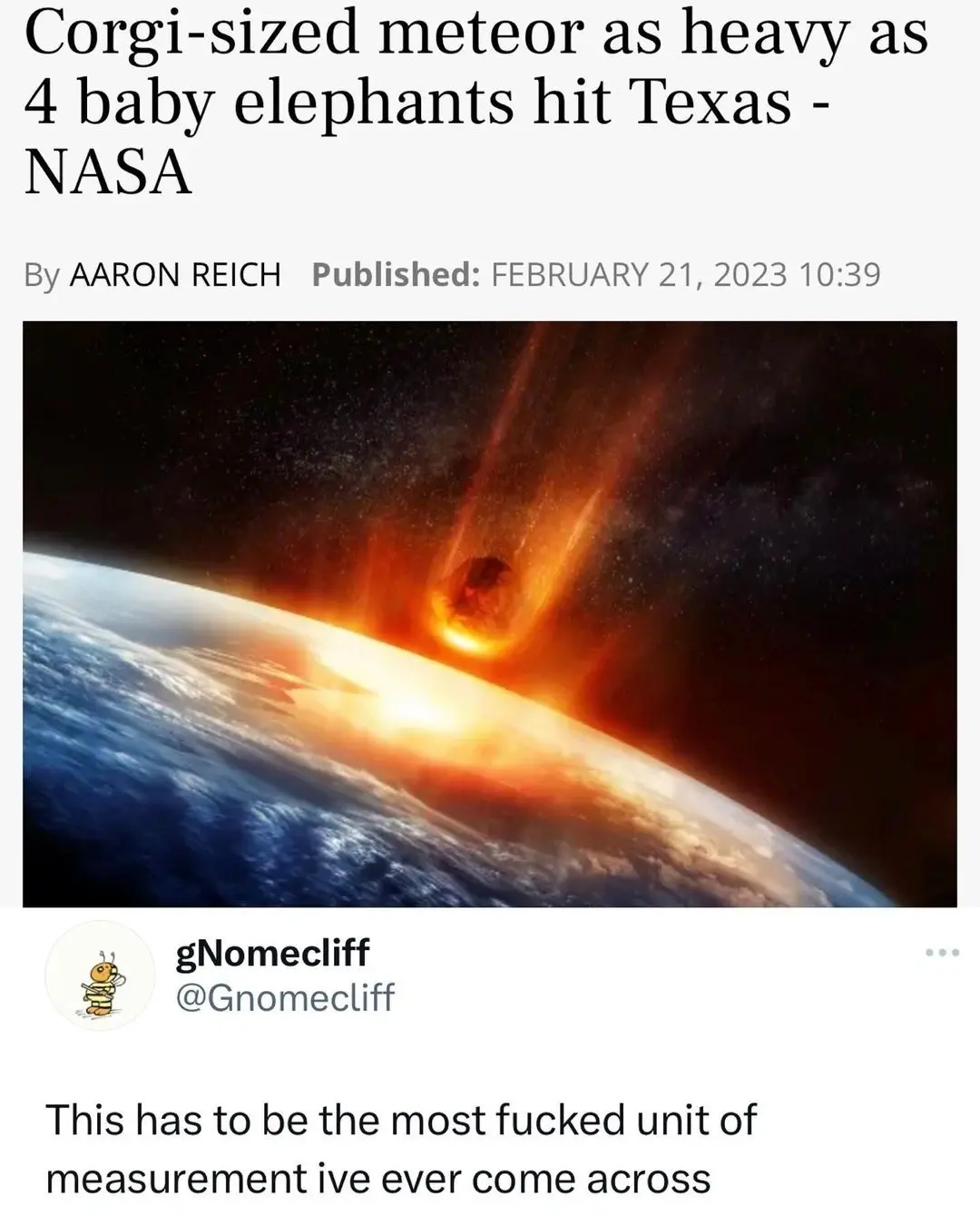
It seems baby elephants weight 100-200 kg depending on the species, let’s say 150
Corgis are 50-70 cm in length, let’s say 60
If we assume that the meteoroid was a sphere with a diameter of 1 Corgi length, that would make the density
150 kg / (τ/3 * (60 cm / 2)^3) ≈ 2652 kg/m³
If we assume that the meteoroid was the same volume as a Corgi, it’s a bit more difficult to estimate. Corgis are kind of like a cylinder with 60 cm height and 20 cm diameter. That would put the density at
150 kg / (τ/2 * (20 cm / 2)^2 * 60 cm) ≈ 7958 kg/m³
Both are reasonable for a meteoroid; the first one would likely be an S-type asteroid (consists of silicates), the second an M-type (consists of metals).


That sounds surprisingly dense; what was that thing made of?
It seems baby elephants weight 100-200 kg depending on the species, let’s say 150
Corgis are 50-70 cm in length, let’s say 60
If we assume that the meteoroid was a sphere with a diameter of 1 Corgi length, that would make the density
150 kg / (τ/3 * (60 cm / 2)^3) ≈ 2652 kg/m³
If we assume that the meteoroid was the same volume as a Corgi, it’s a bit more difficult to estimate. Corgis are kind of like a cylinder with 60 cm height and 20 cm diameter. That would put the density at
150 kg / (τ/2 * (20 cm / 2)^2 * 60 cm) ≈ 7958 kg/m³
Both are reasonable for a meteoroid; the first one would likely be an S-type asteroid (consists of silicates), the second an M-type (consists of metals).
Huh. Thanks. Turns out baby elephants weigh less and corgis are longer than I thought.
Maybe it’d’ve been better to use metric, after all.
Who are you, who are so wise in the ways of science?