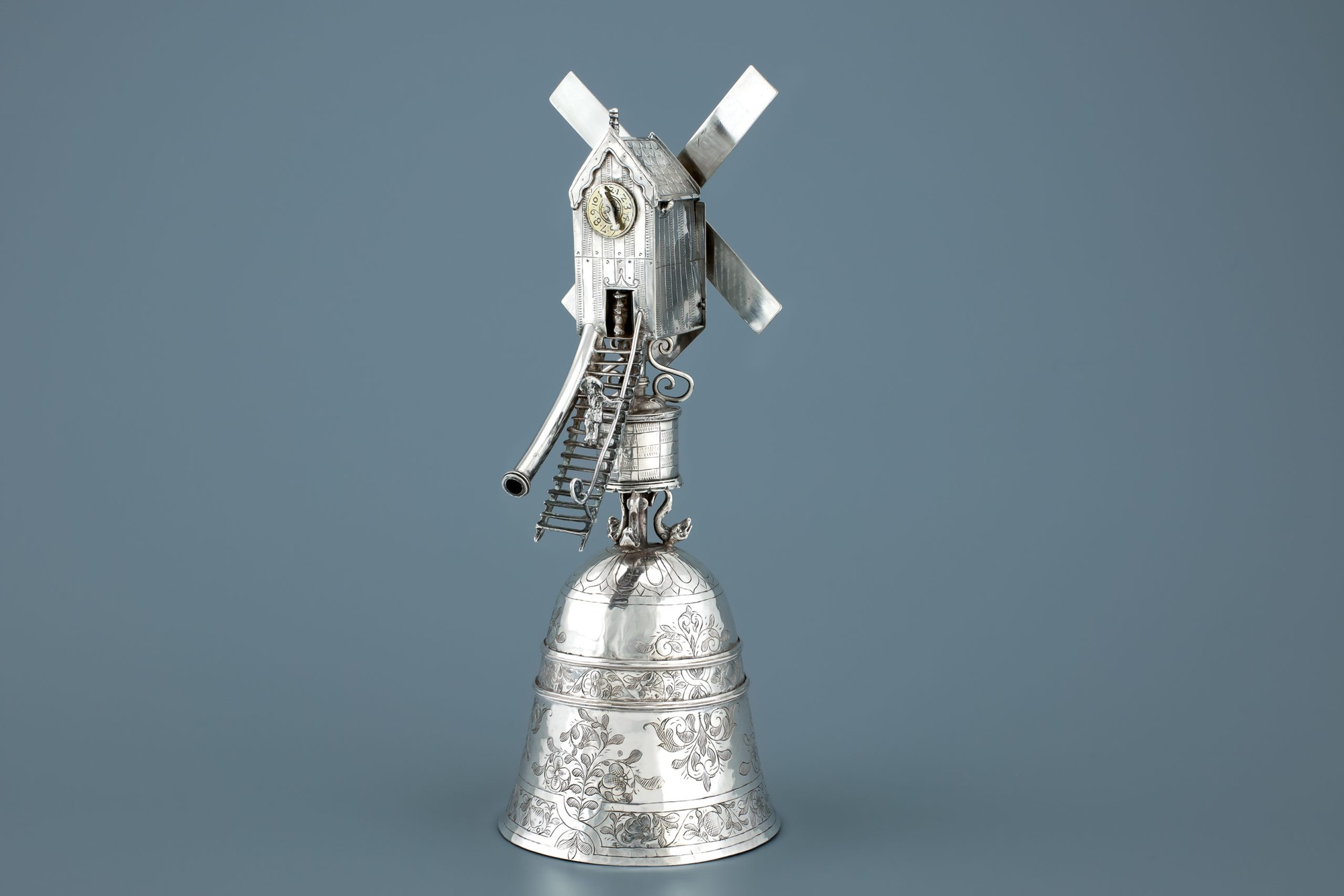
https://www.endlich.nl/collection/a-dutch-silver-windmill-cup/
The feet of these cups are in the form of the top part of a windmill and therefore they cannot be set down until they have been drained. The cup itself, usually divided into horizontal bands, might be decorated with engraved strapwork, flowers, drinking-songs, names or monograms.
Before drinking the cup one had to blow through the blowpipe on the backside, by which the sails were set in motion. At the same time a hand was set in motion indicating a figure from one to twelve. The hand indicated the number of beakers the drinker had to empty if he did not empty the cup before the sails stopped.
This windmill cup is a very early example: the oldest extant Dutch windmill cup was made in Leeuwarden by Cornelis Floris around 1580.
It summons Don Quixote when you need a ride home from the bar.
So, mostly beer/ale I presume. What do we know about what kind of ale they would be drinking, and it’s attributes? I don’t imagine grapes grew that well in the netherlands.
I have previously read their malting wasn’t as good as it is today, and it was often done on like racks over woodstoves, but I am skeptical of the sources claiming all of their beer was a half percent alcohol or whatever, sounds like more sobriety squad propaganda that revises all history to remove/repudiate any positive contributions of drugs and alcohol and minimize it’s use. Whether it’s in alcohol not transmitting water borne disease, or opium’s ability to treat diarrhea.
I don’t doubt potency was less generally, a half a percent is so low it’s like the revisionists got too greedy to make a believable case.
I don’t know about historical recipes for malt or hop ratios. I do know that there is a wide variety of yeast with a range of working temperatures ranging from around 5-35 C° (40-95 freedom degrees). The racks over a stove would work for some yeasts and produce beer after 3-4 days. I understand that brewing was pretty sophisticated in the 1600s even if the science was not fully understood.
Oh yeah, the malting I guess is part of this, they sprout the grain, and then heat it to kill it, converting starches to sugars that can be fermented by yeast. The old methods often had sort of racks over woodstoves and the sprouted grain would be turned to try and heat it to around 200 degrees F or so evenly. Or something to that effect, it’s a pain, I am looking to start malting after I can find a good source of food grade human barely, not animal feed stuff which is all I can find in 50 pound sacks (20 dollars,) and people on brewing groups were discouraging me from it due to how much work it is to malt properly, and how difficult it is. But with malted barely at 1.50 or more a pound I pretty much have to if I want to save money on brewing.
But some claim the ancients were so bad at malting their beer was half a percent alcohol. I don’t doubt sometimes it was, I don’t buy that it always was. But as you say this was pretty well down the line from the ancients they had been brewing for a long time.
But the yeast meant a lot too, that’s why wines always had the emphasis on the region and year, because they were using the wild yeasts, often after foot crushing the grapes, and the local yeasts varied by region and year and quality of crop. Not sure how they did beer if that too was by wild yeast and at what point they starting cultivating yeast cultivars. But this was well before germ theory, so like they still generally thought vinegar came from rope, that some rope made better vinegar, as that’s how they unknowingly introduced the mother of vinegar into alcohol. The prevailing wisdom was still spontaneous generation, that life sprung up on it’s own. Idk how they viewed alcohol exactly, but they thought for instance river mud made eels, just naturally.
Louis Pasteur and Koch and those guys weren’t until like the 19th century that finally disproved those experts definitively even as others throughout history knew the prevailing wisdom was bullshit. But you didn’t go around telling experts they were wrong unless you wanted to get burned at the stake or thrown in a cell or a nuthouse or whatever so there weren’t many loud challenges to the established order until the age of reason sort of allowed it, and even then Pasteur got viciously attacked, but gave it back to them hard.
The wine trade was massive at the time, so it may have been (foreign) wine!
but I am skeptical of the sources claiming all of their beer was a half percent alcohol or whatever, sounds like more sobriety squad propaganda that revises all history to remove/repudiate any positive contributions of drugs and alcohol and minimize it’s use.
Sounds like Small Beer, which is basically made from the leftovers after brewing actual beer. It was popular, but because it was cheap and not water, not because real beer wasn’t preferred.
That is interesting, I basically did the same thing with cider this year, got apples and pressed them and threw the pressed bits in a maple syrup boiler, a 2x4x6" pan and fired it a bit with water then drained it off and pressed it again. Not sure it was worth the effort, but I threw some yeast in some and some is slightly alcoholic, not quite enough to enjoy it though. Some also went vinegar, anything under 5% can get vinegar mother in there and turn it.
Just finished off the last of my full strength hard cider actually, although I’ve 10 gallons of cider vinegar now, full strength not including small cider batches as such. Will throw a bunch of like cabbage and onions and garlic and jalapenos and zuchini and cucumber in there when I get a chance I love vinegar I just have too much of it. This is on top of I don’t even know, at least 30 if not 50 gallons of vinegar from years of batches that got infecte (maple syrup wine/vinegar.)
At least some understandible and fun game, not another ice moping in front of the brick nightmare.
Funner than cannon fodder for the spaniards I’m sure, or the 30 years war to defend protestantism. Both around this time period.