40 years ago, Akinator would be called AI. Basically a fuzzy logic system that classifies 5-level inputs among millions of characters/animals/objects, with both overt and less-obvious machine learning plus moderation.
That’s user-submitted content. Whenever Akinator fails to guess, it asks you to identify the character so it can improve itself, and will have you type its name if it’s new. The subtitle is to differentiate characters who have the same name. Example: Monika / President of Doki Doki Literature Club. But some people write jokes there. This one is a real slogan of a movement, but isn’t funny and should be removed. The moderators are busy removing overt racism, homophobia and approving characters’ avatars though. Still, you can suggest a change of the name/subtitle if you finish the game.
Idk what their stance on genAI is, for example whether they allow generated avatars or if they allow bots to improve the question bank, but they worked well before 2020.
The image or the flash game Akinator? Akinator is a 20 Questions device that’s basically just been hooked up to a fandom wiki. You could buy handheld toys that did the same thing in the 90’s just without the the pop culture awareness.
Crazy to find that out. Spent a while messing with the thing again, it adds new answers in almost immediately. Also since a bunch of people started trying to prompt it to suggest Charlie’s bullet, it started guessing it often
It hasn’t been hooked up to a fandom wiki, it just feels like it. The authors just grinded to create a decent matrix of questions and characters until the product became good enough to be fun, at which point users happily answered irrelevant questions here and there to add to the knowledge. They also had users add new characters and submit questions, snowballing it into a giant “machine-learned” yes/no-question-based knowledge base.
No, it’s not a language model. It does not process any language, the question strings are static descriptions of the weighted values.
If Akinator had a language model, it would never ask “is your character a sea animal” after you said No to “is your character an animal” because you’ve ruled out the bigger set. But it does ask such questions, which means it can’t even notice the basic linguistic operation where adding a qualifier creates a subset. It just doesn’t know the answer to the broader question for some of the currently most probable characters, just the answer to the narrower, at which point it will ask the latter to rule some out even if it’s clear to a human that one implies the other.
You’re right. I should have said “neural network” or algorithm or something. I didn’t mean to play it up, I mean those are generally more rudimentary than people think they are.
But I think it’s backtracking on questions like that because it expects people to give wrongful answers or to change their minds. Also some answers actually require you to give a lead at first then contradict yourself later like that in order to reach. Like “Mary Madeleine’s Skull relic” instead of just “a skull”
Yeah, that’s definitely part of it. I think it reduces the weights of earlier questions as the game progresses.
Also, it seems to have memory between games: if you answered “yes” to a very specific question, it is way more likely to ask it in the next game. This is because it’s hard to think of completely original characters each time: if one’s first character was a British politician, the next one is very likely to be British and/or a politician.
It is a kind of fuzzy logic and machine learning system, basically 1970s tech but with lots of user-submitted data. Definitely would be called AI up until like 2010 but the constant evolution of the term because of tech improvement and hype keeps turning once cutting-edge AI into “well yeah, computers can do that”.


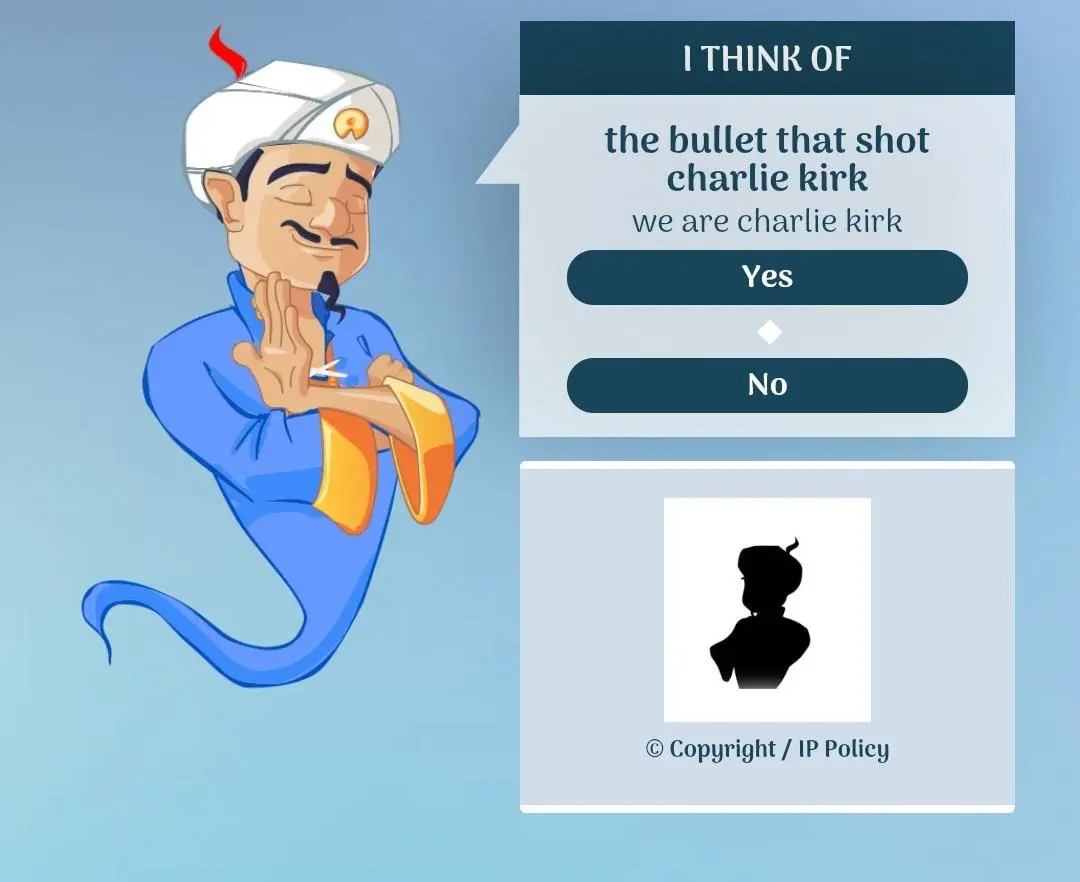
I do not get this at all. Is it AI generated?
40 years ago, Akinator would be called AI. Basically a fuzzy logic system that classifies 5-level inputs among millions of characters/animals/objects, with both overt and less-obvious machine learning plus moderation.
I’m referring to the text “we are Charlie kirk”. The sentence makes no sense.
That’s user-submitted content. Whenever Akinator fails to guess, it asks you to identify the character so it can improve itself, and will have you type its name if it’s new. The subtitle is to differentiate characters who have the same name. Example: Monika / President of Doki Doki Literature Club. But some people write jokes there. This one is a real slogan of a movement, but isn’t funny and should be removed. The moderators are busy removing overt racism, homophobia and approving characters’ avatars though. Still, you can suggest a change of the name/subtitle if you finish the game.
Idk what their stance on genAI is, for example whether they allow generated avatars or if they allow bots to improve the question bank, but they worked well before 2020.
The image or the flash game Akinator? Akinator is a 20 Questions device that’s basically just been hooked up to a fandom wiki. You could buy handheld toys that did the same thing in the 90’s just without the the pop culture awareness.
The image most likely is just a simple photoshop.
Almost correct except this is a real answer.
Crazy to find that out. Spent a while messing with the thing again, it adds new answers in almost immediately. Also since a bunch of people started trying to prompt it to suggest Charlie’s bullet, it started guessing it often
It hasn’t been hooked up to a fandom wiki, it just feels like it. The authors just grinded to create a decent matrix of questions and characters until the product became good enough to be fun, at which point users happily answered irrelevant questions here and there to add to the knowledge. They also had users add new characters and submit questions, snowballing it into a giant “machine-learned” yes/no-question-based knowledge base.
Yeah I’m realizing now this is basically a LM but reversed because it asks questions and you give responses. The responses are all value weighted
No, it’s not a language model. It does not process any language, the question strings are static descriptions of the weighted values.
If Akinator had a language model, it would never ask “is your character a sea animal” after you said No to “is your character an animal” because you’ve ruled out the bigger set. But it does ask such questions, which means it can’t even notice the basic linguistic operation where adding a qualifier creates a subset. It just doesn’t know the answer to the broader question for some of the currently most probable characters, just the answer to the narrower, at which point it will ask the latter to rule some out even if it’s clear to a human that one implies the other.
You’re right. I should have said “neural network” or algorithm or something. I didn’t mean to play it up, I mean those are generally more rudimentary than people think they are.
But I think it’s backtracking on questions like that because it expects people to give wrongful answers or to change their minds. Also some answers actually require you to give a lead at first then contradict yourself later like that in order to reach. Like “Mary Madeleine’s Skull relic” instead of just “a skull”
Yeah, that’s definitely part of it. I think it reduces the weights of earlier questions as the game progresses.
Also, it seems to have memory between games: if you answered “yes” to a very specific question, it is way more likely to ask it in the next game. This is because it’s hard to think of completely original characters each time: if one’s first character was a British politician, the next one is very likely to be British and/or a politician.
It does! I’m curious if it’s using that memory from games with your specific IP address or with other people who played recently
deleted by creator
Ok i completely forgot about that game. I probably played it once. But I was more referring to the very very strange English in the picture.
Oh interesting
No AI, just good old programming. Akinator was made long before AI slopified thinking.
Isn’t it AI in classic means, not generative ai
It is a kind of fuzzy logic and machine learning system, basically 1970s tech but with lots of user-submitted data. Definitely would be called AI up until like 2010 but the constant evolution of the term because of tech improvement and hype keeps turning once cutting-edge AI into “well yeah, computers can do that”.